Having a Google search bar right on your home screen is like having a direct line to all the world’s information, without even opening an app. Basically, you’ll be using your phone’s built-in widget feature. For Android users, this means long-pressing your home screen, tapping “Widgets,” and then finding and dragging the Google search widget into place. If you’re an iPhone user, you’ll swipe right to your Today View or long-press the home screen, tap the plus sign, find the Google widget, and add it. It’s a super handy shortcut that saves you time and clicks every single day.
Tutorial – How To Add Google Search Bar On Home Screen
Getting that convenient Google search bar widget onto your phone’s main screen is simpler than you might think, whether you’re rocking an Android phone or an iPhone. We’re going to walk through the exact steps to make sure you can quickly search for anything you need, right from your home screen, giving you instant access to information.
Step 1: Identify your device’s operating system (Android or iOS).
Before we dive in, it’s super important to know if you’re using an Android phone or an iPhone, because the steps are a little different for each. Think of it like needing a specific key for a specific lock; knowing your phone type helps you grab the right one.
When you know which system you’re on, you can follow the steps that are perfect for your device. Don’t worry, neither process is complicated, but they do start in slightly different places.
Step 2: For Android users, long-press an empty spot on your home screen.
Go ahead and put your finger down on an empty space on your phone’s background and hold it there for a second or two. This action is like waving a magic wand that brings up all your home screen customization options.
After you long-press, you’ll usually see a small menu pop up at the bottom or sides of your screen. This menu often includes options like “Wallpapers,” “Widgets,” and “Settings” or “Home screen settings.”
Step 3: Tap on “Widgets” from the menu that appears.
Once that menu shows up, look for the “Widgets” option and give it a tap. This button is your gateway to a whole library of mini-apps and shortcuts that you can place directly on your home screen.
The widgets section is where all the cool, dynamic elements live, not just static app icons. It’s like opening a toy box full of interactive gadgets for your phone.
Step 4: Scroll through the widgets and find “Google.”
Now you’ll see a long list of available widgets from all the apps you have installed on your phone. You’ll need to scroll through this list until you spot the section for “Google.”
Sometimes, Google might have a few different widgets, like Google Drive, Google Photos, or Google News. What you’re looking for is the specific “Google Search” widget, which usually has a microphone icon and a search bar design.
Step 5: Tap and hold the Google search bar widget and drag it to your desired home screen location.
Once you’ve found the Google search widget, tap and hold it, then drag it out of the widget drawer and onto any open spot on your home screen. As you drag, you’ll see a preview of where it will land.
You can often adjust the size of the widget by dragging its edges after you’ve placed it. This lets you make it bigger or smaller to fit perfectly with your other apps and icons.
Step 6: If you have an iPhone, swipe right on your home screen to access the Today View, or long-press an empty spot on your home screen.
For iPhone users, you have a couple of starting points. You can either swipe right from your main home screen to get to the “Today View,” which is where many widgets live. Alternatively, with iOS 14 and later, you can simply long-press any empty area on your home screen, just like an Android user would.
Long-pressing your home screen on an iPhone will make all your app icons jiggle, and you’ll see a plus (+) sign appear in the top left corner, which is exactly what we want.
Step 7: Tap the “+” icon in the top left corner of the screen.
Whether you’re in the Today View or you’ve long-pressed your home screen, tapping this plus sign opens up the widget gallery. This is where Apple keeps all the widgets available from your installed apps.
Consider this widget gallery your personal customization store for your iPhone. It’s packed with all sorts of handy shortcuts and information displays.
Step 8: Search for “Google” in the search bar at the top or scroll down to find it.
Once the widget gallery is open, you can either use the search bar at the very top to type “Google” and quickly find it. Or, if you prefer, you can just scroll through the list of apps until you locate Google.
Just like on Android, you might see several Google-related widgets. Make sure you select the one specifically designed as a search bar, often featuring the colorful Google logo and a search icon.
Step 9: Tap “Add Widget” and then drag it to your main home screen if desired.
After selecting the Google search widget, you’ll usually see a preview and a button that says “Add Widget.” Tap that, and it will place the widget on your Today View or in an empty spot on your home screen.
If it lands in the Today View, but you want it directly on your main app grid, simply tap and hold the widget from the Today View and drag it over to your desired home screen page. Then, tap “Done” in the top right corner to lock it in place.
Once you’ve completed these steps, you’ll have a super convenient Google search bar sitting right there on your home screen, ready for you to type or speak your queries instantly. It’s like having a direct portal to the internet without any extra clicks or app openings, making your phone even more efficient for daily tasks and quick information gathering.
Tips For Adding Google Search Bar On Home Screen
- Customize its appearance: On many Android phones, after placing the Google search bar, you can tap and hold it again to get options for changing its color, shape, or even making it transparent. iPhones offer different widget sizes.
- Utilize voice search: Most Google search widgets come with a microphone icon right there. Tapping it lets you speak your search query instead of typing, which is incredibly fast when you’re on the go.
- Ensure the Google app is installed: If you can’t find the Google search widget in your widget list, double-check that you actually have the main Google app installed on your phone. The widget comes from that app.
- Experiment with placement: Don’t just stick the search bar in the first available spot. Try placing it at the top, bottom, or center of your most-used home screen page to see what feels most natural and convenient for you.
- Check your launcher settings (Android only): If you’re using a third-party launcher on Android, sometimes widget access can be slightly different. Dive into your launcher’s settings if you’re having trouble finding the widget options.
- Consider multiple widgets: On Android, you can usually add the Google search bar to multiple home screen pages if you want it accessible from anywhere.
Why can’t I find the Google search bar widget on my phone?
There are a few common reasons. First, make sure you have the official Google app installed on your device, as the widget comes from that application. Second, ensure you’re looking in the right place, typically by long-pressing your home screen and selecting “Widgets” (Android) or using the “+” icon in the widget gallery (iPhone). Sometimes, older phone models or specific custom launchers might have limited widget support, but this is rare.
Can I change the size or appearance of the Google search bar widget?
Absolutely! On Android, after you place the widget, you can often tap and hold it again. This usually brings up handles around the widget that let you drag and resize it. Some Android phones also offer options to change the widget’s color, transparency, or shape directly from the long-press menu. For iPhones, when you’re adding the widget, you’ll typically be given choices for different sizes (small, medium, large), but customization beyond that is limited.
Will adding the Google search bar widget slow down my phone or drain my battery faster?
Not at all, you really don’t need to worry about that. Widgets like the Google search bar are designed to be very lightweight and efficient. They don’t constantly run complex processes in the background that would significantly impact your phone’s performance or battery life. Think of it as a convenient shortcut, not a demanding application.
Can I have the Google search bar on more than one home screen page?
Yes, you certainly can, especially if you’re an Android user. You can repeat the steps to add the Google search bar widget to as many different home screen pages as you like. For iPhone users, widgets are generally placed on a single home screen page or the Today View, but you can always move it between different pages if you wish.
How do I remove the Google search bar widget if I don’t want it anymore?
Removing the widget is just as easy as adding it. Simply tap and hold the Google search bar widget on your home screen. On Android, you’ll usually see an option to “Remove” or a trash can icon appear, which you can drag the widget to. On an iPhone, long-pressing the widget will bring up a menu where you can select “Remove Widget,” then confirm your choice.
Summary Of How To Add Google Search Bar On Home Screen
- Identify your device (Android or iOS).
- Long-press home screen (Android).
- Tap “Widgets” (Android).
- Find “Google” widget (Android).
- Drag widget to home screen (Android).
- Swipe right or long-press home screen (iPhone).
- Tap “+” icon (iPhone).
- Search for “Google” widget (iPhone).
- Add widget and place on home screen (iPhone).
Conclusion
Getting the Google search bar onto your home screen is a small change that makes a huge difference in how you interact with your phone every single day. It’s like upgrading your car with a GPS that’s always on and always visible, saving you the hassle of fumbling with maps or apps. You’re essentially streamlining your digital life, cutting out unnecessary steps, and putting the power of information right at your fingertips. We’ve gone through the precise steps to make this happen, whether you’re an Android devotee or an iPhone aficionado, ensuring everyone can enjoy this handy feature.
Think about how many times a day you need to look something up. A quick fact check, a recipe ingredient, the weather, directions, or just a random thought that pops into your head. Each of those moments traditionally requires unlocking your phone, finding the browser or Google app, tapping to open it, and then finally typing your query. With the Google search bar proudly displayed on your home screen, you skip those intermediary steps. It’s a testament to smart design, making technology work harder for us, not the other way around. This isn’t just about saving a few seconds; it’s about reducing friction in your daily routine, allowing for a more fluid and intuitive phone experience. It’s a prime example of how small tweaks can lead to significant improvements in user convenience.
So, go ahead and give it a try if you haven’t already. Experiment with different placements on your home screen, or even try out some of the customization options available for the widget. You might find that having instant access to search truly transforms how you use your smartphone. It unlocks a new level of efficiency, making your device feel even more like a natural extension of your thoughts and needs. The convenience of knowing how to add Google Search bar on home screen is a simple yet powerful tool in your digital toolkit, ready to serve you at a moment’s notice. Embrace the simplicity and enjoy the power of instant information.

Matthew Burleigh has been writing tech tutorials since 2008. His writing has appeared on dozens of different websites and been read over 50 million times.
After receiving his Bachelor’s and Master’s degrees in Computer Science he spent several years working in IT management for small businesses. However, he now works full time writing content online and creating websites.
His main writing topics include iPhones, Microsoft Office, Google Apps, Android, and Photoshop, but he has also written about many other tech topics as well.
Read his full bio here.
When smartphones first started to gain popularity, the prospect of printing something from them seemed like a pipe dream. Printers were already hard enough to deal with on a computer, and it seemed unlikely that it could work on a phone.
But the Google Docs app started adding new features like the ability to add small numbers in Google Docs , and it became apparent that the app was going to gain most of its desktop counterpart’s functionality.
Now we are also able to print from Google Docs on our iPhone or Android device, and it’s surprisingly accessible.
Most modern printers have some sort of network compatibility, meaning that devices on the same network as the printer can use that printer if they have that capability.
Mobile phones, but those that use the iOS and Android operating systems, are now able to print wirelessly to printers that support it. Plus, most of the apps that you would want to print from, such as creative apps and productivity apps, will usually support some type of printing functionality in addition to the other features they offer, like file sharing .
Our guide below will show you how to print through the Google Docs app on your iPhone or Android phone, plus we will address some of the common issues that might arise if you can’t make it work.
How to Print from the Google Docs Mobile App
- Open Docs.
- Choose a document.
- Tap the three dots.
- Select Share & export .
- Choose Print .
- Touch Select Printer .
- Chose a printer.
- Tap Print .
Our guide continues below with additional information on printing from the Google Docs app, including pictures of these steps.
How to Print from Google Docs on an iPhone (Guide with Pictures)
The steps in this section were performed on an iPhone 11 in iOS 14.6. These steps will also work on other iPhone models using this same version of iOS, as well as in most other versions of iOS. I am using the most current version of the Google Docs app that was available at the time this article was written.
Step 1: Open theDocsapp on your iPhone.
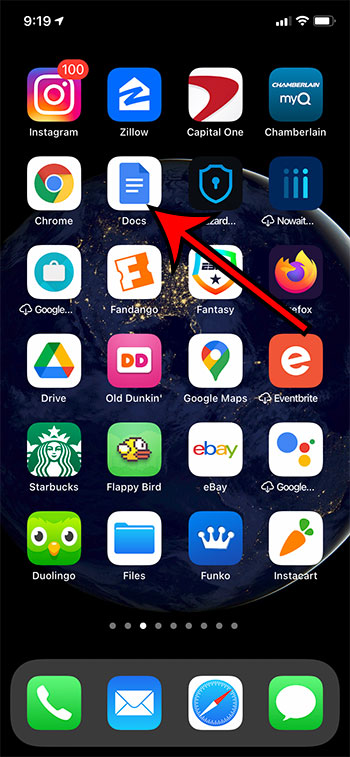
Step 2: Select the document that you want to print.
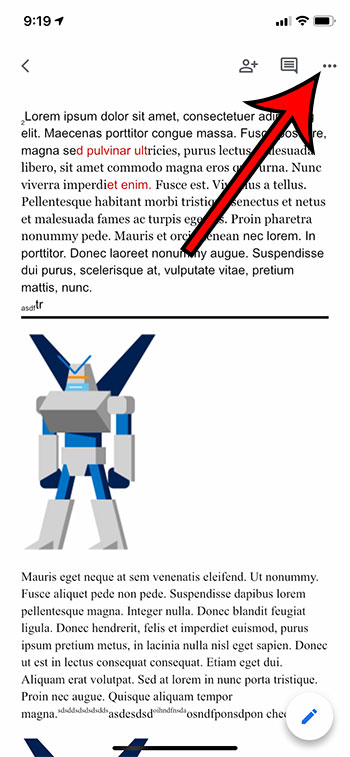
Step 3: Touch the three dots at the top-right of the screen.
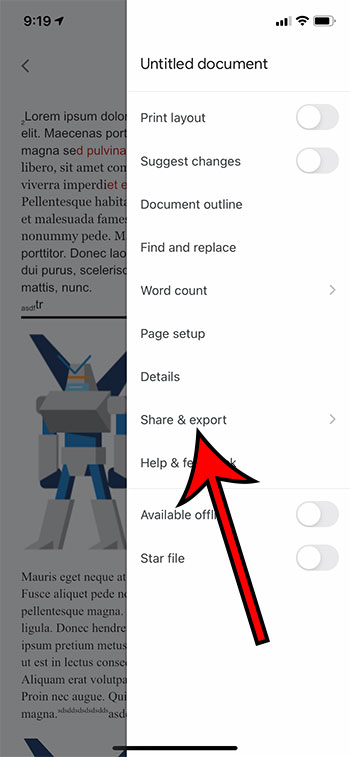
Step 4: Select theShare & exportoption.
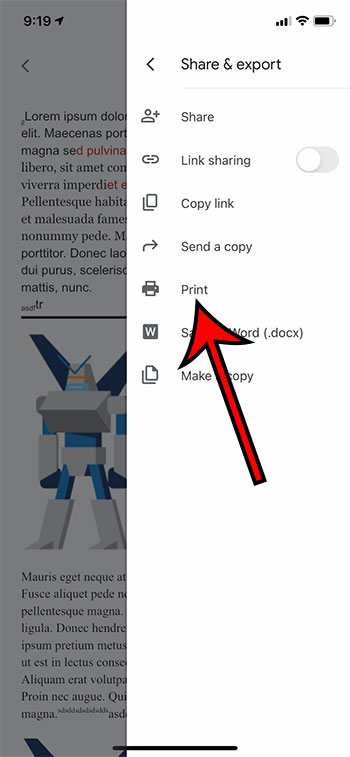
Step 5: ChoosePrint.
Step 6: Tap theSelect Printeroption.
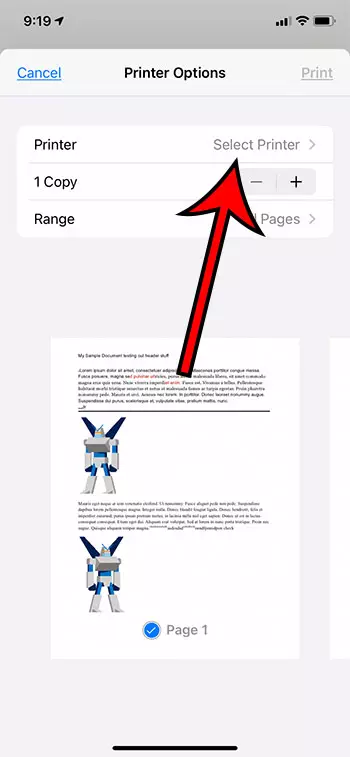
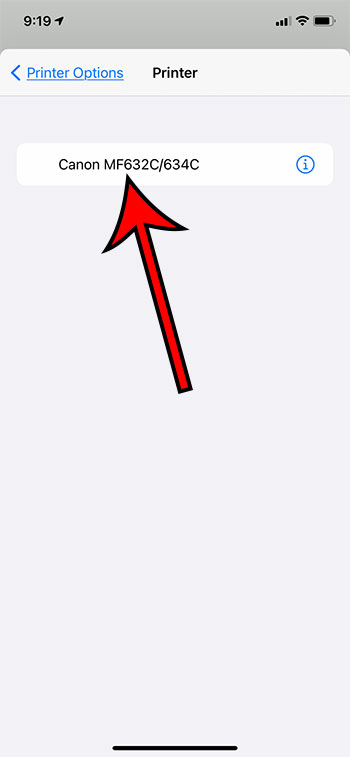
Step 7: Choose your printer.
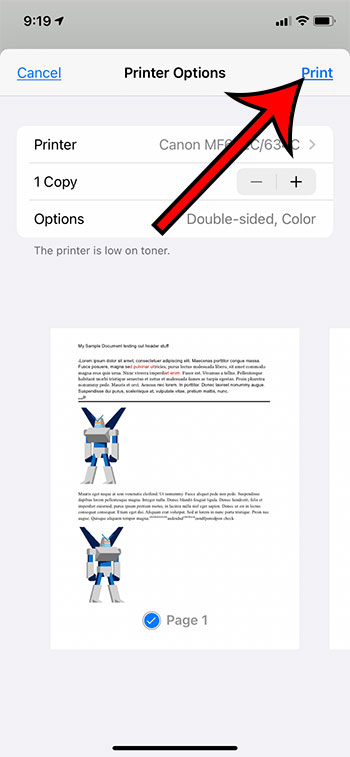
Step 8: TapPrintat the top-right corner of the screen.
Our article continues below with information on how to print from your Android device.
How to Print from Google Docs on Android (Guide with Pictures)
The steps in this section were performed on a Google Pixel 4A, using Android 11. I am using the most current version of the Docs app that was available when I wrote this article.
Step 1: Swipe up from the center of the screen.
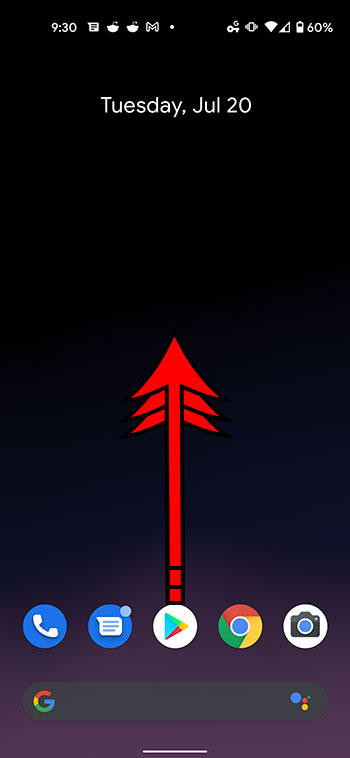
Step 2: Touch theDocsicon.
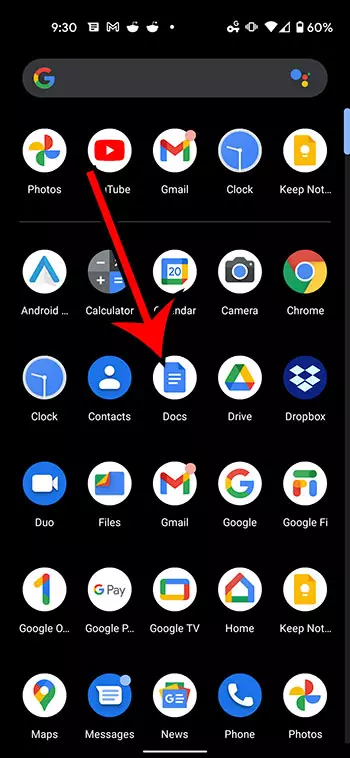
Step 3: Choose the document from your Google Drive that you want to print.
Step 4: Tap the three vertical dots at the top of the screen.
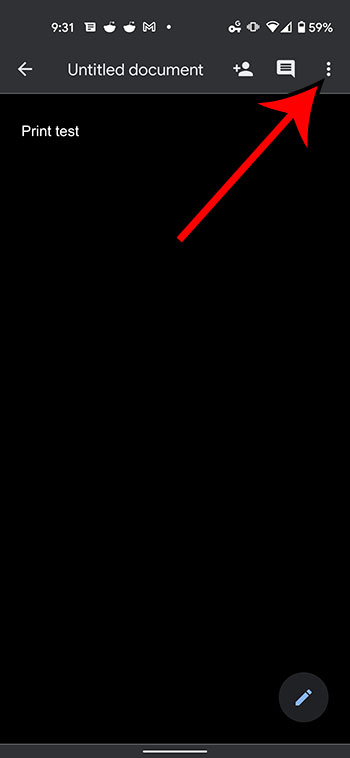
Step 5: Select theShare & exportoption from the menu on the right side of the screen.
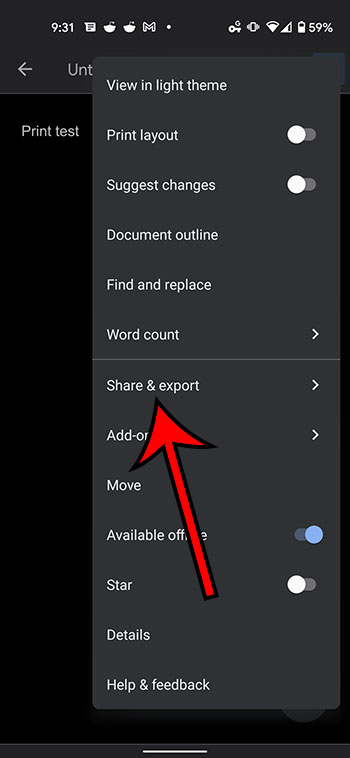
Step 6: ChosePrintfrom the list of sharing options.
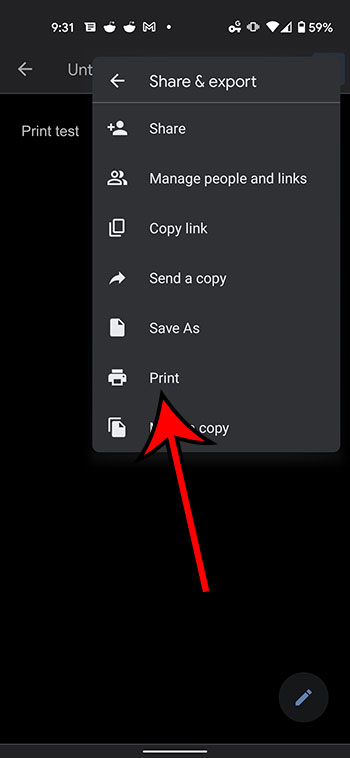
Step 7: Touch theSelect a printerdropdown at the top of the screen.
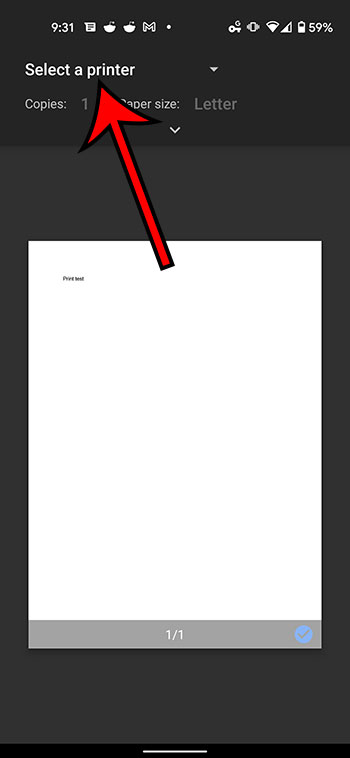
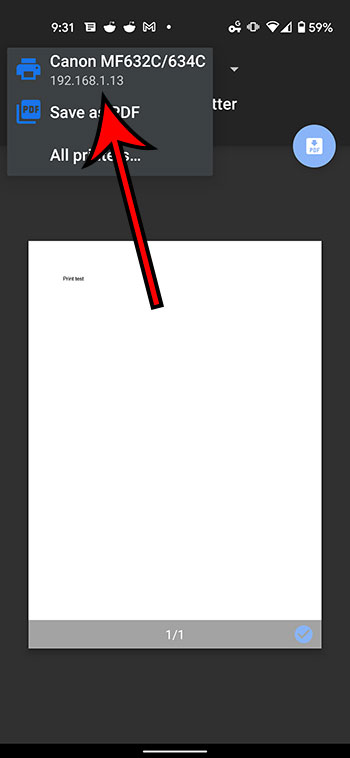
Step 8: Select the desired printer from the list of printing options.
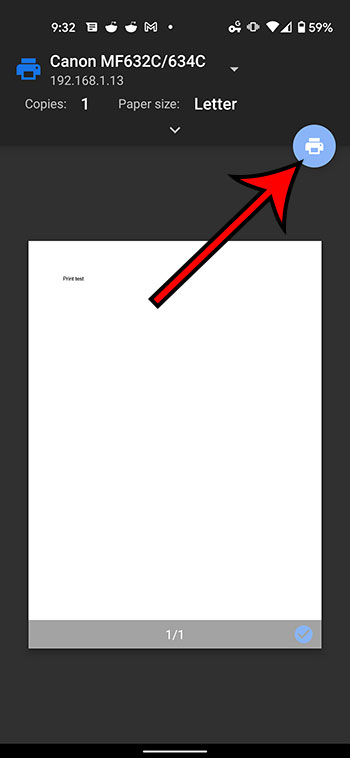
Step 9: Tap thePrinticon.
Our article continues below with additional information on printing from Google Docs.
Why Isn’t My Printer Listed?
Trying to resolve printing issues can be a tricky prospect, as printers are notoriously difficult to work with. When you combine this with the fact that you are printing from a mobile device, then there is a strong possibility that something isn’t going to work properly.
The first thing to check when you are trying to print is that your mobile device is connected to the same wireless network as the printer. If your iPhone or Android device is not on Wi-Fi, then you probably won’t see your printer.
A second consideration is that the printer may not be turned on. Many modern printers will turn off if they haven’t been used in a while. If you don’t see the printer but know that it should be there, try power cycling the printer (turning it off and on again) then wait a few minutes to see if it shows up in your mobile device’s printer list.
One final option to check is whether or not the printer is AirPrint compatible. Since you aren’t able to install print drivers on your mobile device, your printer will use a feature called AirPrint so that it can communicate with your phone. However, not all printers have this feature. Additionally, not all printers are network compatible. If your printer isn’t connected to your local network, either wirelessly or via an ethernet cable, then you probably won’t be able to communicate with the printer through your smartphone.
What is Google Cloud Print
There is a feature that is available as part of your Google Account that is called Google Cloud Print. If you have installed the Chrome browser on your computer and have added it as a printer that is available through Cloud Print, then this gives you some additional printing options.
After you select the Print option from the Share & export menu, you will see Google Cloud Print option listed there as well. If you choose that option you can follow the instructions on screen to select a printer and send it there. This means that you can even print Google Docs files on a printer that is in a completely different location.
How to Print from Google Docs on a Laptop or Desktop Computer
Printing a Google Docs document from your computer via a Web browser is a similar process to printing other documents. I am going to perform the steps below using the Chrome browser, but you can also use another browser like Firefox, Edge, or Safari.
Step 1: Navigate to https://docs.google.com and open the Google Docs file that you would like to print.
Step 2: Select File at the top-left of the window.
Step 3: Choose the Print option at the bottom of the menu.
Step 4: Adjust the print settings as needed, then click the blue Print button.
More Information on How to Print from Google Docs on iPhone or Android
The number of options that you can adjust when printing from your iPhone or Android device is pretty large.
When you have the Printer options menu open on your iPhone you will be able to specify the number of copies that you want to print, as well as the range, whether or not to print double-sided, and whether you want to print in black and white or color. Other document settings can be changed through the Page setup menu that is accessible from the menu where you selected the Share & export option.
The number of printing options on Android is greater, although you might initially have trouble locating them. After you choose the Print option from the Share & export menu, then select your printer, there will be a small downward-facing arrow in the top section. If you tap that arrow you will have these options:
- Copies
- Paper size
- Color
- Orientation
- Two-sided
- Pages
- More options
If you choose more options then you will be given the option to install additional device services, or to manage existing services.
While this article is focused specifically on printing from mobile phones, the same steps will work to print documents on an iPhone or iPad, as the Docs app and the printing process is similar for both of those iOS devices.
Additional Sources
Matthew Burleigh has been writing tech tutorials since 2008. His writing has appeared on dozens of different websites and been read over 50 million times.
After receiving his Bachelor’s and Master’s degrees in Computer Science he spent several years working in IT management for small businesses. However, he now works full time writing content online and creating websites.
His main writing topics include iPhones, Microsoft Office, Google Apps, Android, and Photoshop, but he has also written about many other tech topics as well.
Read his full bio here.
Featured guides and deals
