Getting MMS (Multimedia Messaging Service) working on your iPad is a breeze. This means you can send and receive picture messages and videos just like on your phone. First, make sure your iPad is linked to your iPhone. Then, enable MMS on your iPhone and set up Text Message Forwarding. Finally, check your iPad settings to ensure everything is synced up. Voila! You’re ready to roll with MMS on your iPad.
How to Enable MMS Messaging on iPad
Before diving into the steps, let’s clarify what you’re about to do. You’ll be linking your iPad to your iPhone, enabling MMS on your iPhone, and setting up Text Message Forwarding. This allows your iPad to receive and send MMS messages.
Step 1: Connect your iPad to your iPhone
Ensure both devices are logged into the same Apple ID.
Having the same Apple ID on both devices is crucial because it allows them to communicate seamlessly. Check your Apple ID by going to “Settings” on both devices and ensuring the same email is displayed.
Step 2: Enable MMS on your iPhone
On your iPhone, go to “Settings,” then “Messages,” and toggle on “MMS Messaging.”
This step is vital because if MMS messaging isn’t enabled on your iPhone, your iPad won’t be able to send or receive these types of messages. Make sure it’s turned on.
Step 3: Set up Text Message Forwarding
Still on your iPhone, go to “Settings,” then “Messages,” and tap “Text Message Forwarding.” Choose your iPad from the list.
Your iPhone will show a code that you need to enter on your iPad. This code ensures that the right device is linked and ready to forward messages.
Step 4: Enter the verification code on your iPad
A code should appear on your iPad. Enter this code on your iPhone to verify the connection.
This step is just a security measure that ensures your devices are correctly linked. Once the code is entered, your devices will sync up for messaging.
Step 5: Check MMS settings on your iPad
On your iPad, go to “Settings,” then “Messages,” and ensure that your Apple ID is enabled for iMessage.
This final step ensures that your iPad is set up to send and receive messages using your Apple ID. If everything is synced correctly, you should now be able to handle MMS messages.
After you complete these actions, your iPad will be able to send and receive MMS messages. You can now share pictures, videos, and more, just like on your iPhone.
Tips for Enabling MMS Messaging on iPad
- Ensure both your iPhone and iPad are updated to the latest iOS version to avoid compatibility issues.
- Keep both devices within close range, especially during the setup process, to ensure they sync properly.
- Make sure your carrier supports MMS messaging; if not, contact them for support.
- Regularly check for iOS updates, as Apple frequently releases improvements and bug fixes.
- If you encounter issues, try restarting both devices and ensuring they’re connected to a stable Wi-Fi network.
Why can’t I send MMS on my iPad?
You might not have MMS enabled on your iPhone, or your devices might not be properly linked through Apple ID. Double-check the steps above.
Do I need a cellular plan for my iPad to send MMS?
No, as long as your iPad is connected to a Wi-Fi network and linked to an iPhone with a cellular plan.
Can I enable MMS on iPad without an iPhone?
Unfortunately, no. You need an iPhone to enable Text Message Forwarding, which is key for MMS on your iPad.
What if I don’t see my iPad in the Text Message Forwarding list?
Make sure both devices are logged into the same Apple ID and connected to the same Wi-Fi network.
Will this work with non-Apple phones?
No, this setup only works with Apple devices. Non-Apple phones won’t appear in the Text Message Forwarding list.
Summary
- Connect your iPad to your iPhone.
- Enable MMS on your iPhone.
- Set up Text Message Forwarding on your iPhone.
- Enter the verification code on your iPad.
- Check MMS settings on your iPad.
Conclusion
Enabling MMS messaging on your iPad opens up a whole new world of communication possibilities. Imagine being able to text your vacation photos directly from your iPad while lounging by the pool. If you’ve followed the steps in this guide, you’re already set up and good to go!
Remember, having both devices updated and synced with the same Apple ID is key. If you run into any hiccups, don’t stress. It might just take a quick restart or a little tweak in the settings. And hey, if all else fails, Apple’s support is just a call away.
Now that you’re a pro at enabling MMS on your iPad, why not explore other features that make your Apple ecosystem even more seamless? Happy messaging!

Matthew Burleigh has been writing tech tutorials since 2008. His writing has appeared on dozens of different websites and been read over 50 million times.
After receiving his Bachelor’s and Master’s degrees in Computer Science he spent several years working in IT management for small businesses. However, he now works full time writing content online and creating websites.
His main writing topics include iPhones, Microsoft Office, Google Apps, Android, and Photoshop, but he has also written about many other tech topics as well.
Read his full bio here.
There is a moon or a crossed-out bell icon next to your iPhone text message because the Hide Alerts option for that text conversation has been turned on. This means that you won’t see notifications for that conversation.
Our article continues below with additional information on the bell next to text message conversations on your iPhone, including how to remove the moon on your iPhone if you are using an older version of iOS, as well as pictures of these steps.
You can also check out our video on YouTube about hiding alerts for more information.
How to Add or Remove a Moon Next to an iMessage on Your iPhone (Newer iOS Versions – Guide with Pictures)
We discussed what to do if you see a crescent moon next to a text message or iMessage on your iPhone, but you may be having trouble with it. This section includes pictures of these steps.
In newer versions of iOS, there is no longer a moon next to a text that has been muted. Now you will see a crossed-out bell icon next to your text instead.
Step 1: OpenMessages.
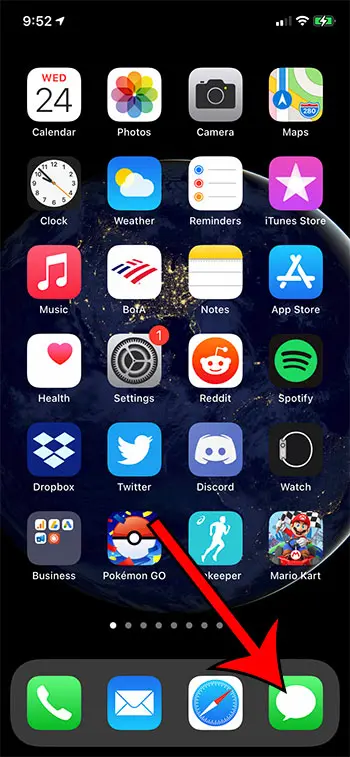
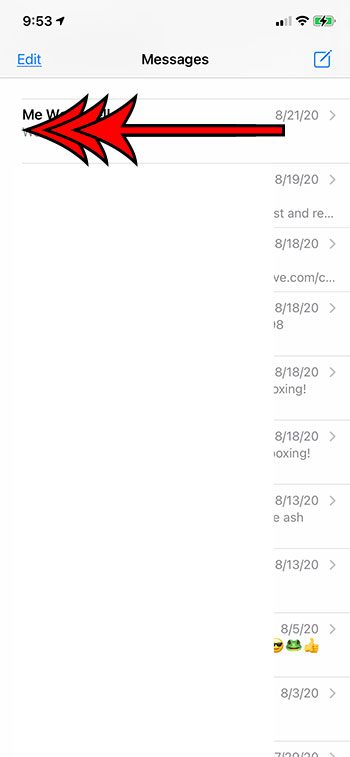
Step 2: Swipe left on an iMessage or text message conversation with a moon or a crossed-out bell icon or that you want to mute.
Step 3: Tap the bell icon to add or remove the moon next to the text message conversation.
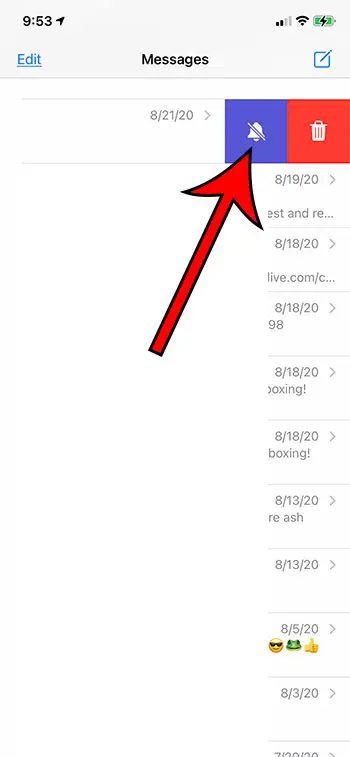
Alternatively, you could open the conversation, select its name at the top of the screen, choose the Info option, and then toggle the Hide Alerts option on or off.
Now that you have completed the why is there a silent symbol on my text message iPhone tutorial steps, you will be able to toggle notifications on or off as needed for some of your conversations.
If you have a group text conversation and need to add someone else to it, then our add contact to group text iPhone article can help you out.
How to Turn Off Do Not Disturb for a Text Message on an iPhone (Older iOS Versions)
The steps in this article were performed on an iPhone 6 Plus in iOS 9.2.
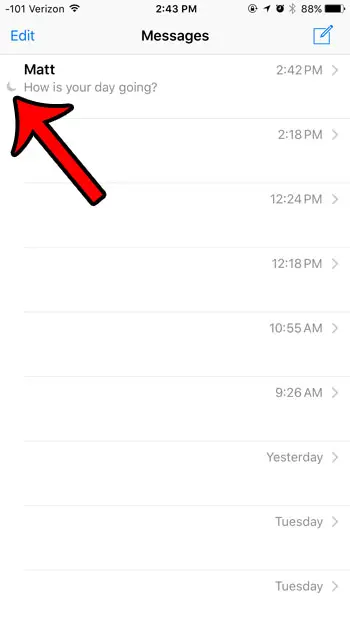
This guide assumes that you currently have a text message conversation that has a crescent moon appearing to the left of it.
Here is how to remove the crescent moon to the left of a text message on an iPhone –
- Open the Messages app.
- Select the conversation with the crescent moon icon.
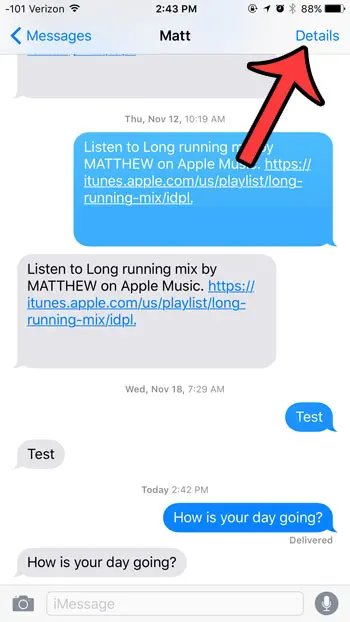
- Click the Details button at the top-right corner.
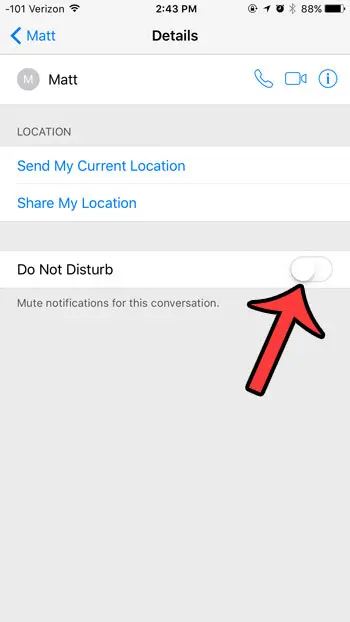
- Tap the button to the right of Do Not Disturb .
These steps are also shown below with pictures –
Step 1: Open theMessagesapp.
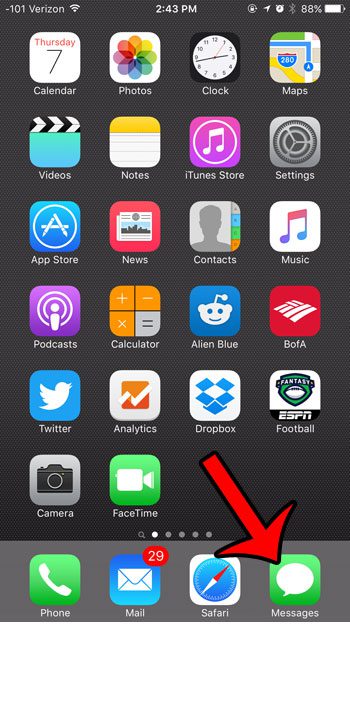
Step 2: Select the message with the crescent moon icon to the left of it.
Step 3: Tap theDetailsbutton at the top-right corner of the screen.
Step 4: Tap the button to the right ofDo Not Disturbto turn it off.
You will receive notifications and remove the crescent moon icon when there is no green shading around the button. The Do Not Disturb feature is turned off in the picture below.
If you no longer wish to receive phone calls, text messages, or FaceTime calls from a contact, then learn how to block a caller on your iPhone .
Difference Between Do Not Disturb and Hide Alerts for iPhone Text Message Conversations
This feature of muting message conversations has been around for several versions of iOS, but its name has changed in more recent versions of iOS.
So, basically, there is no difference between Do Not Disturb and Hide Alerts for iPhone message conversations. The name of the action has been renamed, and the method for performing the action has been made easier.
But while the Do Not Disturb option that is specific to text message conversations is the same as hiding alerts, there is still an overall “Do Not Disturb” feature for the iPhone, and that crescent moon means something else.
Our why is there a clock at the top of my screen article can answer that question if you have a clock icon on your screen and aren’t sure what is causing it.
How to Enable Do Not Disturb for the Entire iPhone
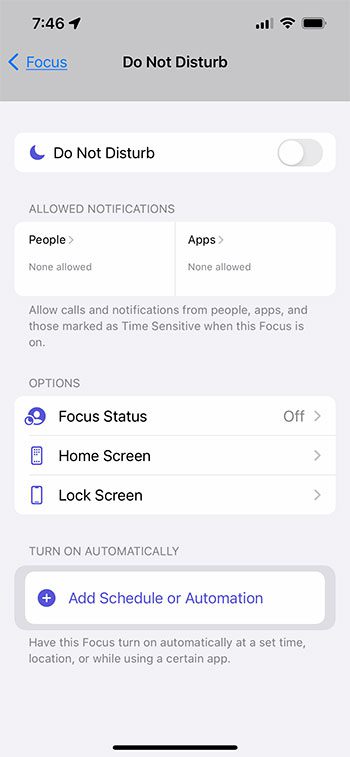
If you open the iPhone Settings app, you will see a Focus option there. When you open that menu, you are going to see a bunch of options that let you silence calls, turn off notifications, and generally just limit interruptions while you are either busy with work or something personal and don’t want to be bothered.
So, by going to Settings > Focus > Do Not Disturb > then adjusting the settings on that menu, you will put your iPhone into Do Not Disturb mode.
Additionally, if you swipe down from the upper right corner of your screen, you will open the Control Center. On this menu is a half-moon icon next to the word “Focus.”
If you tap the moon, it will enable Do Not Disturb mode, which will add the crescent moon to the status bar at the top of the iPhone screen. Tapping it again will remove the crescent moon from the top of the screen.
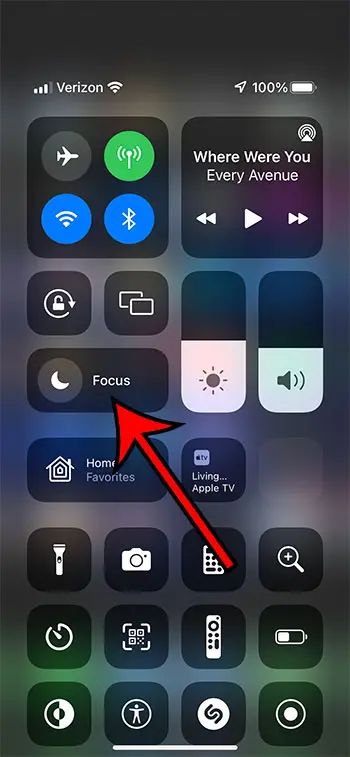
If you tap the word Focus, however, in the control center, then that opens another menu with these options:
- Do Not Disturb
- Sleep
- Driving
- Personal
- Work
Tapping one of those options will engage that focus mode, which will enable the set of actions that you determined from the Settings > Do Not Disturb menu.
Related Topic: AirPod notifications can be an unwanted interruption, so read our how to turn off AirPod notifications article and learn how to stop them.
More Information on Why There is a Crescent Moon Next to a Text Message on Your iPhone
The crescent moon icon was originally just something in iOS that indicated that the Do Not Disturb feature was enabled, but its utility has expanded, including for text messages.
If you are using a newer iPhone model, such as an iPhone 13, and you are using a newer iOS version, like iOS 15, then it’s a lot easier to use the “do not disturb mode” for a text message conversation.
Simply swipe to the left on the message conversation and tap the bell icon. The half-moon icon should then appear there, and you shouldn’t see any new notifications for the text message thread.
Since the moon on iPhone text message thread means that the notifications are muted, you may discover that you actually need to be alerted to new messages for that particular conversation if you are missing things.
Related: How to Find Old Messages on iPhone Without Scrolling
Luckily, you can always just use the swipe left > bell method to remove the moon symbol, or you can select the conversation from the open Messages app, tap the names at the top of the screen, and then tap the Hide Alerts button.
This will re-enable notifications and should start to show alerts again in whatever manner you have set on your device.
Just because you have hidden alerts for a particular contact and their text message conversation doesn’t mean that you won’t still receive messages from them.
You will still be able to open the conversation thread and see their new texts, and you will still be able to send new ones.
Related: How to Turn Off a Scheduled “Do Not Disturb” On an iPhone
What does the moon mean on iPhone?
If you see a crescent moon at the top of your screen, that means that the “Do Not Disturb” feature is currently active on the device.
If you see the moon next to a message conversation, that means notifications are muted.
Our why is there a silent symbol on my text message iPhone guide above provides detailed information, but swiping left on the conversation and tapping the bell icon will let you silence or unsilence a text message or iMessage conversation.
What does a moon mean next to a text?
In older versions of iOS, the moon next to a text indicates that the “Do Not Disturb” setting for that conversation is enabled.
In newer versions of iOS, that moon icon has been replaced with a bell that has a diagonal line through it. This means that “Hide Alerts” is turned on for that conversation.
Generally, a symbol of a moon on iPhone apps or menus is an indication that some type of notification or alert is being silenced. It’s typically a blue crescent moon icon or a gray crescent moon icon that you can disable using the methods in this guide if you want to start getting iPhone notifications again.
How do I get rid of the crescent moon on my iPhone?
You can remove the crescent moon from the top of your iPhone screen by turning off Do Not Disturb.
You can do this by tapping the moon icon in the Control Center or by going to Settings > Do Not Disturb and turning it off from there.
The half-moon symbol is on a button next to the word “Focus,” which you could tap instead to make some additional adjustments to the notifications that you do and don’t want to receive in certain situations.
Why is there a silent symbol on my text message – iPhone?
When you see a silent symbol on a text message, it means that notifications for that conversation are currently muted.
This means the phone won’t vibrate or display any type of notification when someone sends you a message in that conversation.
That symbol is there because you enabled the setting that hides notifications for the conversation, either purposely or accidentally.
What does a half moon next to a text mean?
The half moon next to a text is an indication of an active Do Not Disturb setting for that text message conversation. You can turn it off by opening the conversation, tapping the Details button at the top of the screen, then turning off Do Not Disturb.
In newer versions of iOS, you might not see the crescent moon icon next to your texts anymore.
Now, when you use the “Hide Alerts” feature, you will see a crossed-out bell icon instead.
Why don’t I have a Do Not Disturb option on my iPhone?
If you are using a newer version of the Apple iOS operating system, then the Do Not Disturb feature has been merged with a similar setting called “Focus.”
If you go to Settings > Focus, you will see an option for Do Not Disturb. You can then open that menu, and you will be able to customize a lot of the different apps and settings on your device so that you can get the Do Not Disturb mode set up the way that you want it.
Why is there a moon on my iPhone in iOS 15?
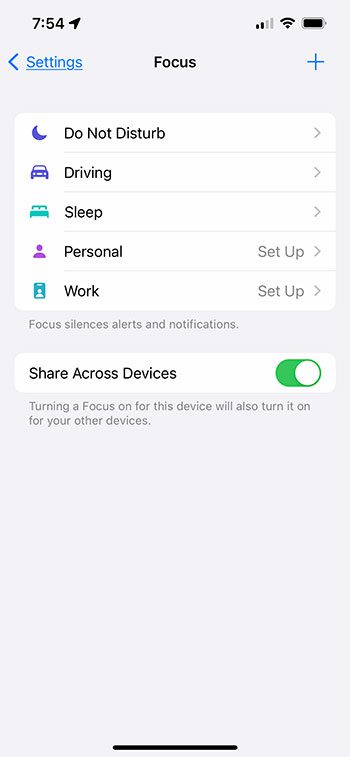
If you have a newer iPhone model , such as the iPhone 13, and it uses the iOS 15 operating system, then the half moon appears at the top of your screen because you have turned on the Do Not Disturb option that is found inside the Focus menu.
This is actually a pretty in-depth feature, and you can do a lot with it to ensure that you are getting the notifications that you need and silencing the ones that you don’t.
The details screen for the Focus feature is shown in the image below.
Here you see that you have options for: – Do Not Disturb – Driving – Sleep – Personal – Work
There is also an option to share these settings across devices and a + icon that you can use to add other modes.
One of the more interesting aspects of this is the fact that you can add some automation to it. For example, you can configure the “Driving” option to turn on automatically when your iPhone senses that you are driving a car.
How do I get rid of the crescent moon on my iPhone 11?
If you see a crescent moon icon at the top of your screen, then you can swipe down from the top-right corner of the screen and tap the crescent moon symbol in the Control Center to turn off Do Not Disturb.
If you see the crescent moon next to a text message conversation, then you can swipe left on it and tap the bell icon to re-enable notifications for that conversation.
Check out our guide on iPhone button shapes if you would like to know more about them, including how to enable them and make your phone a little easier to navigate.
Video About Why is There a Moon Next to My Text (or a Crossed Out Bell)
Summary – Why Is There a Moon or a Crossed Out Bell Next to a Text on My iPhone?
- Open Messages .
- Swipe left on the message with the moon.
- Tap the bell icon to remove the moon.
Conclusion
When you aren’t getting notifications about a text message conversation, especially when it’s one that you are actively participating in, then you may be taking a long time to respond.
This usually isn’t a glitch with your iPhone and is likely due to a silent symbol or a moon icon iPhone symbol that is muting those notifications.
Our tutorial above has discussed this setting and how you can remove the silent symbol on your iPhone text message to start getting those notifications.
Some text message conversations on your iPhone are going to be more active than others.
This is particularly noticeable in group messages with multiple people. But you may be wondering why there is a moon next to a text message on your iPhone, especially if you aren’t getting any notifications for those conversations.
There are a number of different icons and images that appear on your iPhone.
Often, these can include icons in the status bar at the top of the screen, such as the little arrow icon , or they can include symbols that appear within individual apps.
One such icon is a crescent moon that can be displayed to the left of a text message conversation.
This indicates that the notifications for that specific conversation have been muted by turning on the Do Not Disturb option for that conversation.
Our guide below will show you how to disable this setting and remove the crescent moon icon.
Our tutorial on why is the time blue on my iPhone can provide an answer to questions you may have about blue shading around your iPhone’s clock.
- How to Enable iMessage on iPhone 13
Matthew Burleigh has been writing tech tutorials since 2008. His writing has appeared on dozens of different websites and been read over 50 million times.
After receiving his Bachelor’s and Master’s degrees in Computer Science he spent several years working in IT management for small businesses. However, he now works full time writing content online and creating websites.
His main writing topics include iPhones, Microsoft Office, Google Apps, Android, and Photoshop, but he has also written about many other tech topics as well.
Read his full bio here.
Featured guides and deals
