Taking a screenshot on a Gateway laptop running Windows 11 is a straightforward process. Just press the “Windows” key along with the “Print Screen” key, and your screen will be captured automatically. You can find your screenshot in the “Screenshots” folder inside “Pictures” on your laptop. This method is quick and effective, ensuring you can easily capture whatever is displayed on your screen at any given moment.
How to Take a Screenshot on a Gateway Laptop Windows 11
Capturing screenshots on your Gateway laptop running Windows 11 is a breeze. Follow these simple steps, and you’ll be saving images of your screen in no time.
Step 1: Press the Windows Key and Print Screen Key
Hold down the “Windows” key and then press the “Print Screen” key.
You’ll find the “Windows” key on the bottom left of your keyboard, sporting a small Windows logo. The “Print Screen” key is usually located in the upper row, labeled as “PrtSc” or something similar. Pressing these keys together will capture your entire screen.
Step 2: Locate the Screenshot
Open File Explorer and navigate to the “Pictures” folder, then to the “Screenshots” folder.
Once you’ve captured your screen, Windows 11 automatically saves the screenshot in a subfolder named “Screenshots,” which is inside the “Pictures” directory. This saves you the trouble of pasting images manually into image editing software.
Step 3: Open the Screenshot
Double-click your screenshot file to open it.
Your screenshot will be saved as a PNG file, which is a high-quality image format. You can open this file using any photo viewing app on your laptop, such as the Photos app or Paint.
Step 4: Edit the Screenshot
Use an image editor to crop or annotate your screenshot if needed.
You might want to highlight specific parts of your screenshot or crop out unnecessary sections. Windows 11 offers built-in tools like Paint or the Photos app that allow you to perform simple edits.
Step 5: Share or Save the Screenshot
Send your screenshot via email or upload it to cloud storage.
After editing, you can easily share your screenshot with others using email or social media. Alternatively, you can save it to cloud storage like OneDrive for easy access from any device.
After you complete these steps, your screenshot will be ready for whatever you need it. Whether it’s sharing with friends, including in a presentation, or saving for reference, your captured image will be securely stored and easily accessible.
Tips for Taking a Screenshot on a Gateway Laptop Windows 11
- Use the Snipping Tool for more options if you need to capture only part of the screen.
- Remember that screenshots may include personal information, so review before sharing.
- Customize your Screenshot folder location by changing the default path in File Explorer.
- Use keyboard shortcuts like Alt + PrtSc to capture just the active window instead of the whole screen.
- Regularly check for Windows updates to ensure all screenshot features are working correctly.
Can I capture just a part of my screen?
Yes, use the Snipping Tool or Snip & Sketch to select a specific area.
Where are screenshots saved by default?
Screenshots are saved in the “Screenshots” folder inside the “Pictures” directory.
How can I edit my screenshots?
You can use built-in apps like Paint or the Photos app to edit your screenshots.
Can I change where my screenshots are saved?
Yes, you can move the “Screenshots” folder to another location by changing its properties in File Explorer.
What do I do if the Print Screen key doesn’t work?
Try using the Snipping Tool, or check if your keyboard has a different key combination for screenshots.
Summary
- Press Windows Key + Print Screen Key.
- Locate the screenshot in the Pictures folder.
- Open the screenshot file.
- Edit the image if necessary.
- Share or save the screenshot.
Conclusion
So, there you have it—a complete guide on how to take a screenshot on a Gateway laptop running Windows 11. Screenshots are incredibly handy for capturing information, whether it’s a memorable moment during a video call, a detailed error message you need to report, or a snapshot of your favorite game. They act like digital Polaroids, letting you freeze a moment in time with just a few simple keystrokes. Now that you know how to capture and manage screenshots efficiently, you’ll find plenty of opportunities to use this skill. Whether you’re a student, a professional, or just someone who likes keeping digital memories, mastering screenshots is a valuable tool in your digital toolkit. Don’t hesitate to explore other features in Windows 11 to enhance your productivity further. Happy screenshotting!

Matthew Burleigh has been writing tech tutorials since 2008. His writing has appeared on dozens of different websites and been read over 50 million times.
After receiving his Bachelor’s and Master’s degrees in Computer Science he spent several years working in IT management for small businesses. However, he now works full time writing content online and creating websites.
His main writing topics include iPhones, Microsoft Office, Google Apps, Android, and Photoshop, but he has also written about many other tech topics as well.
Read his full bio here.
Featured guides and deals
When smartphones first started to gain popularity, the prospect of printing something from them seemed like a pipe dream. Printers were already hard enough to deal with on a computer, and it seemed unlikely that it could work on a phone.
But the Google Docs app started adding new features like the ability to add small numbers in Google Docs , and it became apparent that the app was going to gain most of its desktop counterpart’s functionality.
Now we are also able to print from Google Docs on our iPhone or Android device, and it’s surprisingly accessible.
Most modern printers have some sort of network compatibility, meaning that devices on the same network as the printer can use that printer if they have that capability.
Mobile phones, but those that use the iOS and Android operating systems, are now able to print wirelessly to printers that support it. Plus, most of the apps that you would want to print from, such as creative apps and productivity apps, will usually support some type of printing functionality in addition to the other features they offer, like file sharing .
Our guide below will show you how to print through the Google Docs app on your iPhone or Android phone, plus we will address some of the common issues that might arise if you can’t make it work.
How to Print from the Google Docs Mobile App
- Open Docs.
- Choose a document.
- Tap the three dots.
- Select Share & export .
- Choose Print .
- Touch Select Printer .
- Chose a printer.
- Tap Print .
Our guide continues below with additional information on printing from the Google Docs app, including pictures of these steps.
How to Print from Google Docs on an iPhone (Guide with Pictures)
The steps in this section were performed on an iPhone 11 in iOS 14.6. These steps will also work on other iPhone models using this same version of iOS, as well as in most other versions of iOS. I am using the most current version of the Google Docs app that was available at the time this article was written.
Step 1: Open theDocsapp on your iPhone.
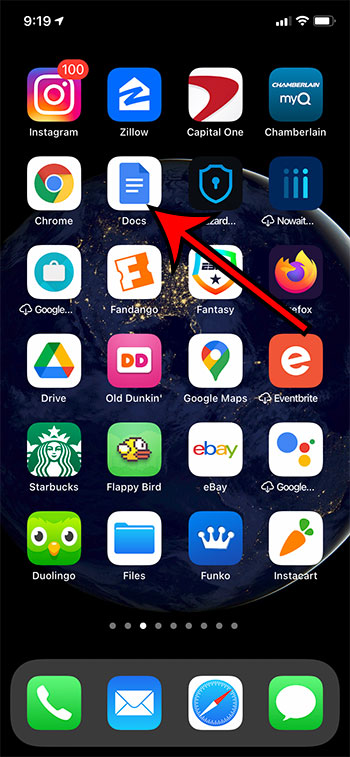
Step 2: Select the document that you want to print.
Step 3: Touch the three dots at the top-right of the screen.
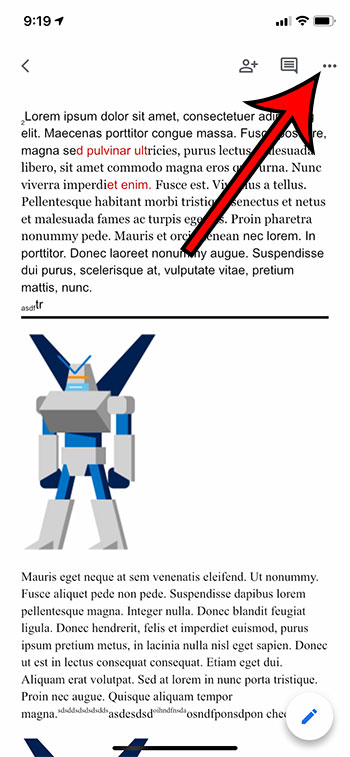
Step 4: Select theShare & exportoption.
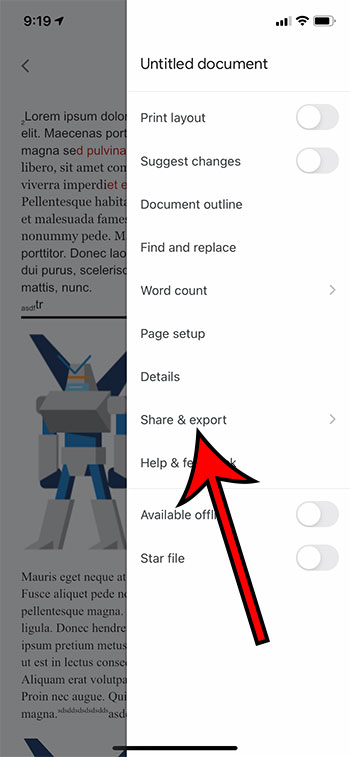
Step 5: ChoosePrint.
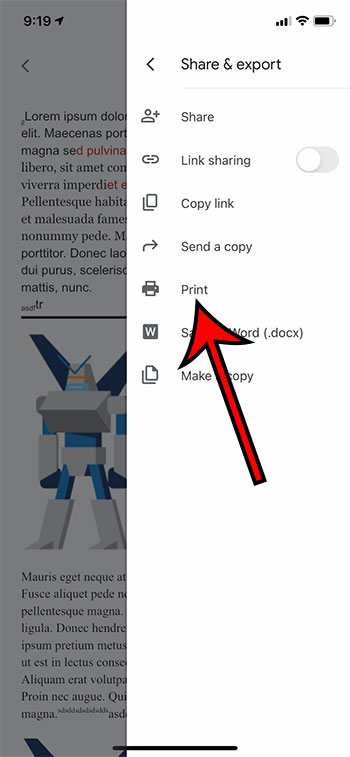
Step 6: Tap theSelect Printeroption.
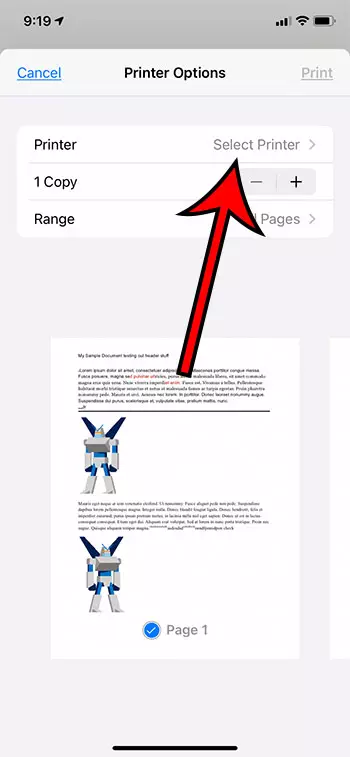
Step 7: Choose your printer.
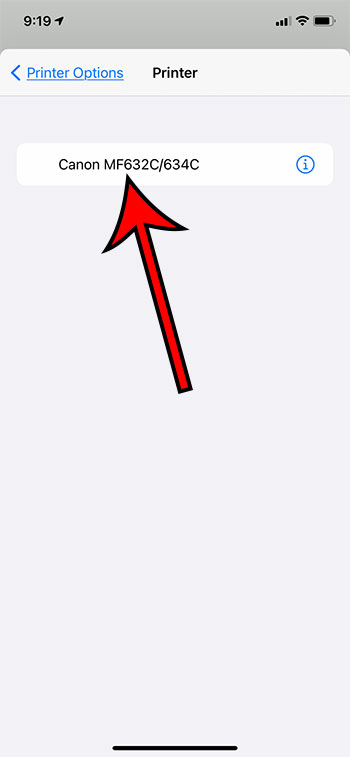
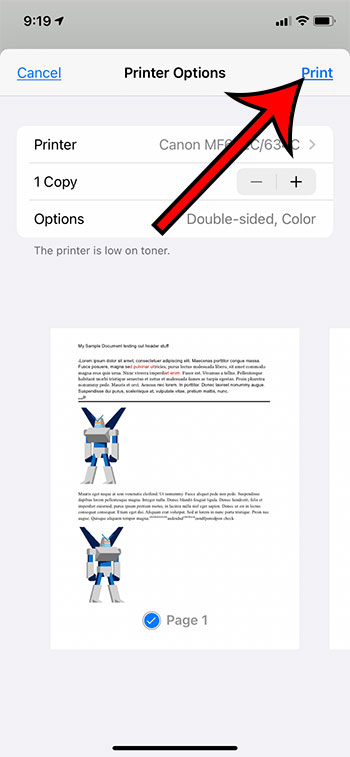
Step 8: TapPrintat the top-right corner of the screen.
Our article continues below with information on how to print from your Android device.
How to Print from Google Docs on Android (Guide with Pictures)
The steps in this section were performed on a Google Pixel 4A, using Android 11. I am using the most current version of the Docs app that was available when I wrote this article.
Step 1: Swipe up from the center of the screen.
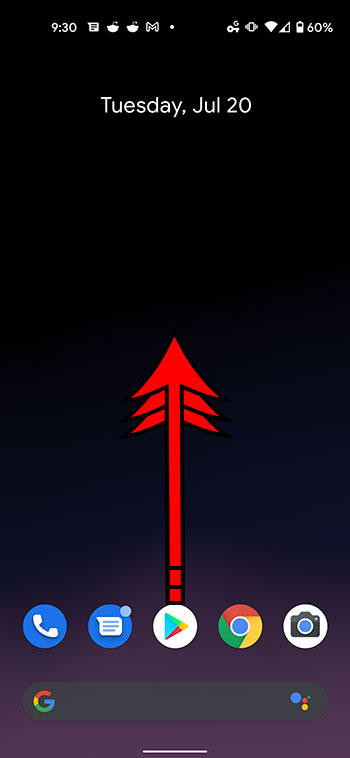
Step 2: Touch theDocsicon.
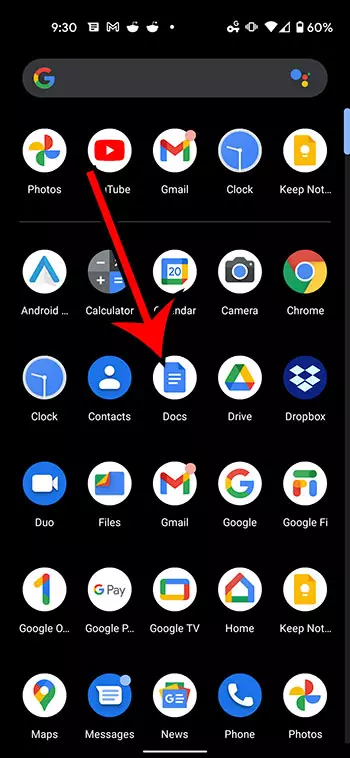
Step 3: Choose the document from your Google Drive that you want to print.
Step 4: Tap the three vertical dots at the top of the screen.
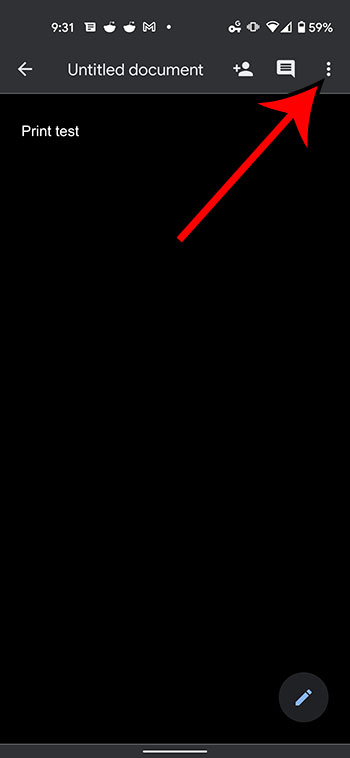
Step 5: Select theShare & exportoption from the menu on the right side of the screen.
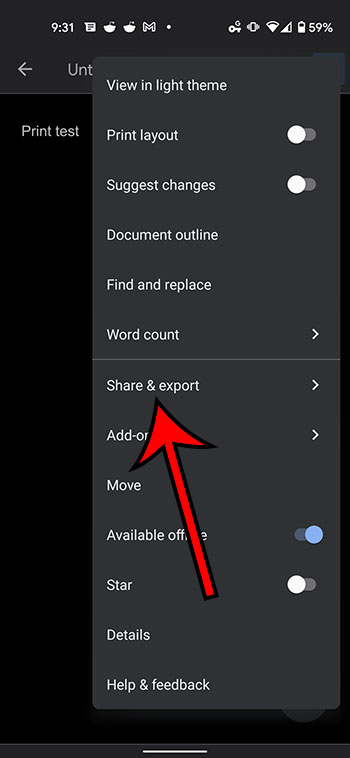
Step 6: ChosePrintfrom the list of sharing options.
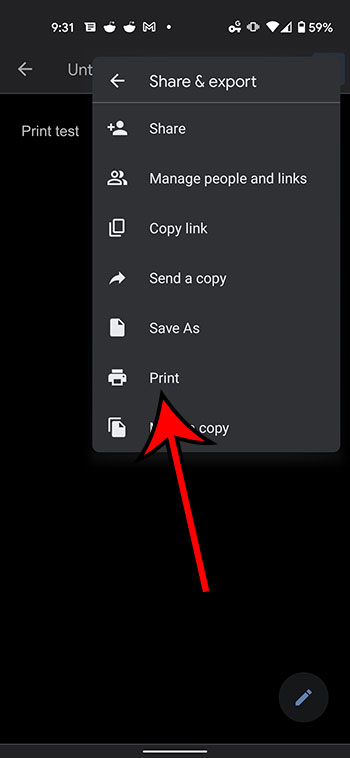
Step 7: Touch theSelect a printerdropdown at the top of the screen.
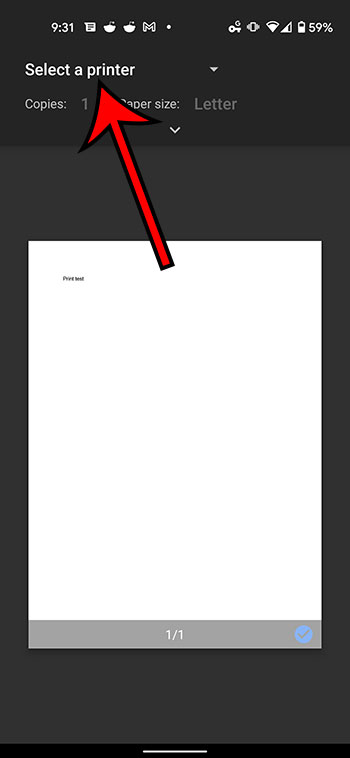
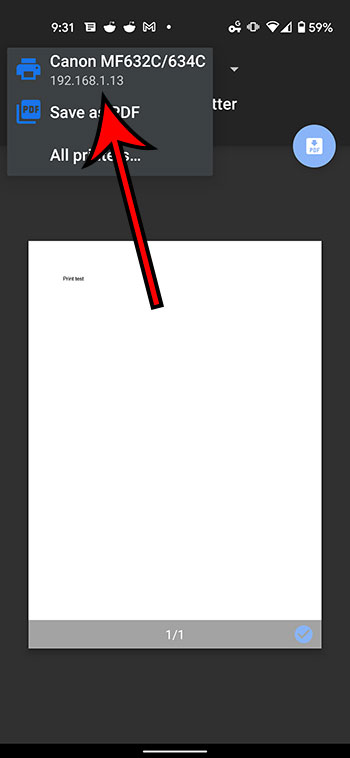
Step 8: Select the desired printer from the list of printing options.
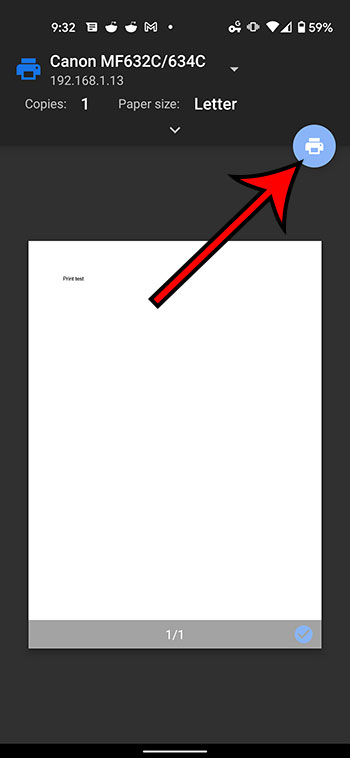
Step 9: Tap thePrinticon.
Our article continues below with additional information on printing from Google Docs.
Why Isn’t My Printer Listed?
Trying to resolve printing issues can be a tricky prospect, as printers are notoriously difficult to work with. When you combine this with the fact that you are printing from a mobile device, then there is a strong possibility that something isn’t going to work properly.
The first thing to check when you are trying to print is that your mobile device is connected to the same wireless network as the printer. If your iPhone or Android device is not on Wi-Fi, then you probably won’t see your printer.
A second consideration is that the printer may not be turned on. Many modern printers will turn off if they haven’t been used in a while. If you don’t see the printer but know that it should be there, try power cycling the printer (turning it off and on again) then wait a few minutes to see if it shows up in your mobile device’s printer list.
One final option to check is whether or not the printer is AirPrint compatible. Since you aren’t able to install print drivers on your mobile device, your printer will use a feature called AirPrint so that it can communicate with your phone. However, not all printers have this feature. Additionally, not all printers are network compatible. If your printer isn’t connected to your local network, either wirelessly or via an ethernet cable, then you probably won’t be able to communicate with the printer through your smartphone.
What is Google Cloud Print
There is a feature that is available as part of your Google Account that is called Google Cloud Print. If you have installed the Chrome browser on your computer and have added it as a printer that is available through Cloud Print, then this gives you some additional printing options.
After you select the Print option from the Share & export menu, you will see Google Cloud Print option listed there as well. If you choose that option you can follow the instructions on screen to select a printer and send it there. This means that you can even print Google Docs files on a printer that is in a completely different location.
How to Print from Google Docs on a Laptop or Desktop Computer
Printing a Google Docs document from your computer via a Web browser is a similar process to printing other documents. I am going to perform the steps below using the Chrome browser, but you can also use another browser like Firefox, Edge, or Safari.
Step 1: Navigate to https://docs.google.com and open the Google Docs file that you would like to print.
Step 2: Select File at the top-left of the window.
Step 3: Choose the Print option at the bottom of the menu.
Step 4: Adjust the print settings as needed, then click the blue Print button.
More Information on How to Print from Google Docs on iPhone or Android
The number of options that you can adjust when printing from your iPhone or Android device is pretty large.
When you have the Printer options menu open on your iPhone you will be able to specify the number of copies that you want to print, as well as the range, whether or not to print double-sided, and whether you want to print in black and white or color. Other document settings can be changed through the Page setup menu that is accessible from the menu where you selected the Share & export option.
The number of printing options on Android is greater, although you might initially have trouble locating them. After you choose the Print option from the Share & export menu, then select your printer, there will be a small downward-facing arrow in the top section. If you tap that arrow you will have these options:
- Copies
- Paper size
- Color
- Orientation
- Two-sided
- Pages
- More options
If you choose more options then you will be given the option to install additional device services, or to manage existing services.
While this article is focused specifically on printing from mobile phones, the same steps will work to print documents on an iPhone or iPad, as the Docs app and the printing process is similar for both of those iOS devices.
Additional Sources
Matthew Burleigh has been writing tech tutorials since 2008. His writing has appeared on dozens of different websites and been read over 50 million times.
After receiving his Bachelor’s and Master’s degrees in Computer Science he spent several years working in IT management for small businesses. However, he now works full time writing content online and creating websites.
His main writing topics include iPhones, Microsoft Office, Google Apps, Android, and Photoshop, but he has also written about many other tech topics as well.
Read his full bio here.
Taking a print screen, or screenshot, on an iPad is a handy way to capture a moment or preserve information displayed on your device. It’s a quick process: just press the Home button and the Sleep/Wake button (or the Volume Up button on newer models without a Home button) at the same time. Release both buttons quickly, and voila! The captured image is automatically saved to your Photos app.
After you complete the action, you’ll hear a camera shutter sound (if your device isn’t on mute), and a thumbnail of the screenshot will briefly appear in the bottom left corner of your screen. You can tap the thumbnail to edit or share the screenshot immediately, or it will disappear after a few seconds and be saved in your Photos app for later access.
Introduction
Screenshots are like digital keepsakes, capturing everything from a high score in a game to an important message in an email. In today’s digital age, knowing how to take a screenshot is almost as essential as knowing how to send a text message. It’s a simple but powerful tool that’s relevant to virtually all iPad users, whether you’re a student taking a snapshot of your online homework, a professional preserving a chart for a meeting, or just someone who wants to share a funny meme with your friends.
Not only does taking a screenshot on an iPad allow you to save information, but it also enables you to share your screen with others without giving them access to your device. It’s an invaluable skill for troubleshooting, creating tutorials, or simply sharing content. Plus, with the rise of social media and digital communication, screenshots have become a staple in our everyday virtual conversations.
Step by Step Tutorial: Taking a Print Screen on an iPad
Before we dive into the specifics, let’s clarify what we’re aiming for here. The following steps will guide you through the process of taking a screenshot on your iPad, ensuring you capture exactly what you need.
Step 1: Locate the necessary buttons on your iPad
For iPads with a Home button, find the Sleep/Wake button (usually at the top) and the Home button (below the screen). For newer models without a Home button, find the Sleep/Wake button and the Volume Up button (on the side).
Locating the buttons is the first crucial step as they are the ones you’ll use to take your screenshot. Make sure you can press them easily.
Step 2: Open the content you want to capture
Navigate to the app, website, or screen you want to take a print screen of.
Ensure that all the information or image you want to capture is visible on the screen. Close any unnecessary pop-ups or tabs that might clutter your screenshot.
Step 3: Press and release the Sleep/Wake and Home buttons simultaneously (or the Sleep/Wake and Volume Up buttons for models without a Home button)
Press both buttons at the same time and release them quickly. You should hear a shutter sound, indicating that the screenshot has been taken.
It’s important to press the buttons simultaneously to avoid locking your screen or going to the Home screen. If you press one button slightly before the other, it may not work.
Pros
| Benefit | Explanation |
|---|---|
| Quick and easy | Taking a screenshot on an iPad is a rapid process that requires only a simple button combination. |
| Instant saving | The captured image is automatically saved to the device’s Photos app, making it immediately accessible. |
| Edit and share | Users have the option to edit or share the screenshot right after taking it, thanks to the thumbnail preview. |
Screenshots are an indispensable part of using a digital device, and the fact that they can be taken quickly and easily is a huge plus. No need to download additional apps or fiddle with complex settings; a couple of button presses and you’re done.
The convenience of having the image automatically saved to the Photos app cannot be overstated. This means no additional steps are necessary to save your work; the iPad takes care of it for you.
Additionally, the ability to immediately edit or share the screenshot adds a layer of functionality. Whether you need to crop, highlight, or draw on the image, these tools are just a tap away, saving you time and effort.
Cons
| Drawback | Explanation |
|---|---|
| Accidental activation | It’s easy to accidentally take a screenshot when attempting to press other buttons. |
| Limited editing tools | The iPad’s native editing features might be too basic for advanced users. |
| Managing storage | Multiple screenshots can quickly take up storage space on your device. |
While the process is user-friendly, there’s a chance of taking a screenshot by accident, especially if you’re trying to press the Sleep/Wake button to lock your device. This can lead to a cluttered Photos app filled with unintentional captures.
For users who need more sophisticated editing options, the native tools provided by the Photos app might not be sufficient. This can necessitate the use of additional apps, which can be a hassle.
Lastly, if you’re a heavy user of the screenshot feature, managing your device’s storage can become a chore. Screenshots, especially if taken frequently, can consume a significant amount of space, requiring you to periodically delete or transfer them to other storage solutions.
Additional Information
When taking a screenshot on an iPad, there are a few extra nuggets of wisdom to keep in mind. Firstly, if you’re not quick to release the buttons, you might end up with a Siri prompt instead of a screenshot. It’s all about timing! Also, did you know that you can immediately edit or mark up your screenshot without even going to the Photos app? Just tap on the thumbnail preview that pops up and it’ll take you to the editing screen.
Moreover, consider organizing your screenshots into albums within the Photos app to keep them neat and easily accessible. And for those worried about privacy, remember that screenshots will capture everything on your screen, so be sure to clear away any sensitive information before snapping away.
Lastly, remember that screenshots are more than just a way to capture information. They can be a means of expressing yourself, sharing your personal screen experiences with the world. So, don’t be afraid to get creative with what you capture.
Summary
- Locate the Sleep/Wake button and the Home button or the Volume Up button.
- Open the content you want to screenshot.
- Press and release the buttons simultaneously.
Can I take a screenshot on an iPad without a Home button?
Absolutely! On newer iPad models without a Home button, you’ll use the Sleep/Wake button and the Volume Up button instead.
Where do my screenshots go on my iPad?
Your screenshots are automatically saved in the Photos app under the Recents album. You can also find them in the Screenshots album.
Can I edit my screenshot after taking it on the iPad?
Yes, you can. Tap on the thumbnail preview that appears after you take the screenshot to edit or markup your image immediately.
What if I can’t press both buttons at the same time?
If you’re having trouble pressing both buttons simultaneously, you can use the AssistiveTouch feature to create a virtual button that takes screenshots.
How do I share my screenshot after taking it?
After taking your screenshot, tap the thumbnail preview to bring up the sharing options, or find the screenshot in the Photos app and use the share button to send it via message, email, or social media.
Conclusion
Taking a print screen on an iPad is a breeze once you know the steps. It’s a skill that bridges the gap between the digital and the tangible, allowing you to capture bits of your digital life and share them with the world. Whether for work, school, or personal use, mastering the art of the screenshot is a modern-day essential.
Now that you’re equipped with this knowledge, go ahead and give it a try. Capture those fleeting moments, preserve important information, and share your screen with confidence. And if you ever need a refresher, just remember: Sleep/Wake + Home/Volume Up, snap, and share. Happy screenshotting!
Matthew Burleigh has been writing tech tutorials since 2008. His writing has appeared on dozens of different websites and been read over 50 million times.
After receiving his Bachelor’s and Master’s degrees in Computer Science he spent several years working in IT management for small businesses. However, he now works full time writing content online and creating websites.
His main writing topics include iPhones, Microsoft Office, Google Apps, Android, and Photoshop, but he has also written about many other tech topics as well.
Read his full bio here.
Featured guides and deals
